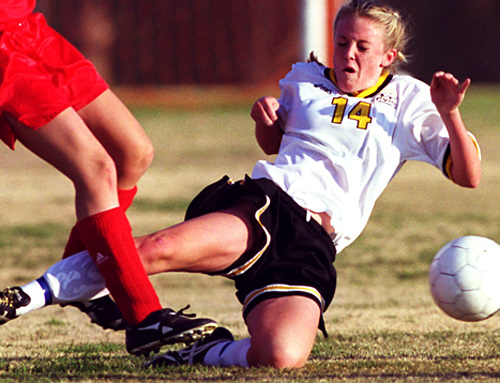
Showing posts with label sports. Show all posts

Monday, September 27, 2010

Sports Injuries Don’t Just Hurt the Body


Most of us who play a sport consider “athlete” as one aspect of our identity.  How important playing a sport is to us can greatly affect how we deal with an injury.  While healing the body is important, the injury to our identity as an athlete can be equally significant.  Some of the possible psychological impacts of sport injuries include:

Temporary loss of identity:  Many athletes connect the way people view them (popularity, respect) to their role in sport.  During the rehabilitation process, there may be a constant comparison to things that they could do, and the way that others used to view them.  These negative thoughts may work against them in their efforts to heal the body.

Feelings of isolation and being left out:  Athletics presents an important social role, and as a result, injured athletes may feel left out of the interaction with teammates, both competitively and informally.  This loss may be as significant as what we would consider a true “loss” such that a grieving process may take place. This will be especially true in the situation of a career ending injury.

Decrease in self-esteem:  For many athletes, self-esteem is connected to performance ability and achievement.  Injury for some athletes may have a significant impact on self-image and long term goal achievement.  This decrease in self-esteem may carry over into academic performance and personal relationships. 

Depending on the severity of the injury, other possible psychological impacts include anger, guilt, post-traumatic stress disorder, helplessness, and depression.  Each of these concerns may contribute to an athletes’ ability to recover well and return to post injury performance, which again can result in depressive symptoms and repeat the psychological pattern.

Here are a few things that parents and coaches can do to help injured athletes heal their minds. 

* Help athletes to acknowledge and recognize the trauma and loss that has occurred, and provide support as they experience the grieving process.  Athletes (and even coaches) sometimes engage in denial regarding the true impact of a sports injury.  This denial can result in additional injuries or negative psychological impacts.

* Provide encouragement and support during the rehabilitation process.  Due to many of the psychological impacts of sport injury, athletes may not be as motivated to engage in the rehab process.  Providing support and acknowledging the barriers may be helpful.

* Normalize their experiences of fear of re-injury.  Athletes may be apprehensive to express their concerns and fears.  Allow them to recognize that fear is a normal reaction, and that they are not alone in that experience. 

* Particularly for career-ending injuries, help athletes re-orient to alternative options.  Many athletes, particularly those who have been playing sports since early childhood, have not had the opportunity to fully develop other identities and options.  Exposing them to those possibilities is important in helping them to feel as though they have a path and some direction. 

* Finally, some athletes have such a difficult experience following a sport injury that counseling or professional support may be necessary.  Keep an eye out for signs of more significant psychological concerns such as increased isolation, poor concentration, changes in appetite, and feelings of hopeless or worthlessness.  These signs indicate that there is a need to go beyond the training room in the healing process.   

Dr. Nyaka Niilampti is a licensed psychologist at Southeast Psych with a Ph.D. in counseling psychology and a master's in sports psychology.  She sees clients of all ages and specializes in performance enhancement, relationship concerns, diversity issues, and the treatment of anxiety and depression.  She can be contacted at 704-552-0116.

Monday, November 2, 2009

Get Your Girls Involved in Sports!

by Nyaka Niilampti


The impact of playing sports for young children is an issue that receives much debate, particularly when more than 20 million children participate in youth sports programs. Although parents frequently wish for their young ones to be engaged in sports, their rationales are often based on a number of factors: ‘because I did it,” learning how to work with others, sportsmanship, and the simple benefits of exercise and being active. Those opposing the idea of youth sport participation argue that sport (or some sports in particular) promotes aggressive behaviors. However, there are significant additional reasons to encourage sport participation for youth, and young girls in particular. Here are six of them:


Greater self-esteem and self-confidence: Research suggests that sport participation psychologically impacts young girls and females differently than it does for males, with higher self-esteem and self-confidence, as compared to their non athlete peers. This self-esteem seems to contribute to greater academic success, less of chance of dropping out of school, and less chance of becoming a teenage mother.


Lower levels of depression: Research suggests that female athletes report lower levels of depression when compared to their non-athlete peers.


Healthier body image: Research suggests that sport participation gives women a sense that their bodies belong to them, producing a self-esteem that is a great antidote for anorectic behavior. While there are some sports that have a higher tendency for disordered eating, in comparison to females in general, athletes tend to view their bodies more realistically.


Greater access to break the glass ceiling: It has also been suggested that females who participate in sport are at an advantage over their non athletic peers. Research argues that because the American business environment is structured and organized based upon a male model, females who have had some interaction in sport have greater access.


Greater academic success and likelihood of graduating college: Despite the theory that athletes are lacking in intelligence and perform poorly in school, high school female athletes tend to have higher grades and graduation rates than their non-participating peers, and college female student athletes boast the highest college graduation rates than female non-athletes and all male students, both athletes and non-athletes.


Lower risk for breast cancer and osteoporosis: Females who exercise at least two hours a week can reduce chances of developing breast cancer by 20-30 percent, and four or more hours of exercise a week (45 minutes a day) can reduce the risk by almost 60% (McTiernan, 2006).


While girls are often as active as young boys in sport, the peak age of participation is 12 or 13, when many girls drop out of sport for a range of reasons. The drop out rate of females in sports is six times that of boys, and occurs during a time in development and identity formation when these characteristics would be most important. However, as females approach adolescence, they become aware of the socially negative aspects of being an athlete. This is the time when they will need the most encouragement, as the potential benefits of continuing (or beginning) become so much greater.


So, encourage them to get involved, and to the best of their abilities, encourage them to remain involved. Young girls will learn so much more than just how to catch a ball.


‘If you Let me Play’

If you let me play.
If you let me play sports. I will like….myself more.
I will have more self-confidence.
If you let me play.
If you let me play!
I’ll be 60% less likely to get breast cancer.
I’ll suffer less depression.
If you let me play sports.
I’ll be more likely….to leave a man who beats me.
I’ll be less likely…to get pregnant before…I want to.
I will learn
I will learn
What it means to be strong…To be strong.
If you let me play…Play sports…If you let me play sports.


Rachel Nelson, Jennifer Smieja, and Angelina Vieira (1996) of theWeiden and Kennedy Ad Agency for the Nike Corp. Some research by Karen Sarpolis, M.D.


McTiernan, A. (2006). Cancer Prevention and Management through Exercise and Weight Control. Boca Raton: Taylor & Francis Group, LLC.


Dr. Niilampti is a licensed psychologist at Southeast Psych. One of her specialties is sports psychology.